November 5, 2014
SPEC Sensor President & CTO to Present at T Sensor Summit – November 13, 2014 – San Diego
November 4, 2014 – Newark CA – Joe Stetter, President and CTO of SPEC Sensors presents a vision for Trillion gas sensor fabrication. Society is moving from concern about food and water quality to concern about the breathable quality of the air. It is now understood that it is not just low levels of chemicals in food and water, but low level chemicals in every breath that matters. Additionally, health monitoring through a better understanding of human respiratory gases is also a growing application. Both of these situations show that there is a real need to bring the high performance of today’s industrial gas sensors to all facets of society. But these applications require high volume production, ultra-low power consumption, small size, lower costs, while still maintaining much of the high performance.
Until recently gas sensing solutions have not been able to meet all of these challenges. The lowest cost gas sensor technologies are often not specific to a particular gas; enabling the possibility of a false reading. The most accurate, stable, and specific gas sensors are not small and have been difficult to make inexpensively at high volumes. Power consumption has been significant for most gas sensing technologies.
At the T Sensor Summit, Joe Stetter brings his nearly 40 years’ experience in gas sensing to describe the options for chemical/gas sensing, along with, how recent emerging manufacturing and sensor packaging technologies are enabling the possibility of inexpensive ultra-low power, small size and high performance sensors; capable of being manufactured at the high volumes needed for Trillions of gas sensors. It will be chemical/gas sensors like these that will bring an explosion of innovation to the Trillion sensor network.
August 15, 2014
By James Morgan
Science reporter, BBC News, San Francisco
Criminals are smuggling billions in US bank notes into Mexico every year, but help could be on the way for border guards.
A machine that can “smell” dollars – like a sniffer dog senses narcotics – is being developed.
For the first time, chemists have captured the unique fragrance of US paper money.
They announced their discovery at the American Chemical Society meeting.
“Money sniffing is an unknown art. No-one had ever tried to find these aromas,” said Dr Joseph Stetter, of KWJ Engineering.
“We found that US currency emits a wide range of volatile organic compounds that make a ‘fingerprint’ we can identify in less than a minute.”
Daunting challenge
His firm is developing a handheld cash detector for border police, called the Bulk Currency Detection System (BCDS).
In the past fiscal year, US officials seized more than $106m in smuggled cash heading to Mexico – the bulk of it laundered drug money.
But that’s only a whisker of the estimated $39bn that crosses the border undetected every year – hidden in clothing, baggage and vehicles.
Current checks are done by guards with dogs – but training is expensive and time-consuming.
Airport-style X-ray scanners have had some success detecting currency – but they are large and impractical for busy border checkpoints.
To find a swifter solution, the US Department of Homeland Security made a public challenge to scientists to develop “a device that will search for and identify bulk quantities of currency – secreted on persons, in hand baggage and luggage, and/or in privately owned vehicles.”
This money-sniffing machine must pass three intimidating challenges.
First – it must be precise enough to pick up the whiff of dollar bills amid a cacophony of background aromas.
“It has to work even in the presence of car exhaust, perfumes, food, and at a range of temperatures and humidity,” said Dr Suiqiong Li, a researcher at KWJ.
“You need a smart algorithm to sort the needle from the haystack.”
Next – it has to deliver a reading within seconds at hectic border crossings. There is no time to send samples off to a lab.
And finally, the probe has to be portable – light enough for a guard walking up and down a line of people, and flexible enough to reach inside vehicles or shipping containers.
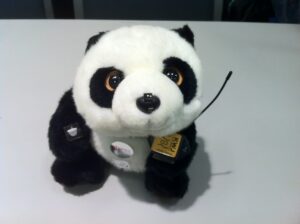
KWJ has already developed sensors for carbon monoxide detectors and alcohol breathalysers – as modelled by their company mascot panda “Sensor Bear”.
Sniffer backpack
To capture the fragrance of money, they collected one hundred used $1 bills in various states – from crumpled and smelly to crisp and shiny.
They sealed the notes in a chamber and warmed them to release vapours at two temperatures: 24C and 40C.
“We saw tremendous variability and contamination – every one of the notes was different,” said Dr Stetter.
But a signature common to all of the bills was eventually teased out.
It turns out this odour comes from a set of trace chemicals, including aldehydes, furans and organic acids.
“The amounts are tiny – at best a small fraction of a ppm [part per million]. This presents a formidable analytical challenge,” the researchers say.
So does the “smell of dollars” come from the ink? Or the bank note itself? The precise source is not likely to be revealed in a published scientific journal – for security reasons, the researchers say.
But having found the perfume, they now face another daunting technical challenge – building a practical device for border police.
Their design is a backpack with a handheld probe. The pack will house a miniature GC-MS (gas chromatograph-mass spectrometer) of the type already used to detect drugs and explosives.
Ultimately, this could be superseded by an “electronic nose” – a sophisticated sensor array.
To sniff for hidden currency, border guards would pass the probe over clothing or into baggage.
A high-intensity reading would indicate that a large stash of money is concealed.
“You smell like a million dollars” may not be a compliment for much longer.
http://www.bbc.com/news/science-environment-28802706
August 14, 2014
By Lucy Westcott
Filed: 8/13/14 at 2:01 PM
Sniffing out illegal wads of cash will soon become easier for border patrol guards with the development of a new device that aims to stem the illicit flow of roughly $30 billion in U.S. currency into Mexico every year.
The Bulk Currency Detection System (BCDS) is a device that can smell money by taking a gas sample from wherever officers think the money might be hidden, be on it travelers, in their luggage or stored somewhere in vehicles or shipping containers. Using sensors, the device can analyze samples in less than a minute, researchers say.
“Everyone knows the smell of money, especially fresh money,” Joseph Stetter, principal investigator for the study and president of KWJ Engineering, says. U.S paper money omits unique gases and leave its own “fingerprint,” a result of the ink used in the printing process and the paper the bills are printed on. Money sheds “volatile molecules,” the kind molecules that most easily travel through the air and stick to surfaces, Stetter says.
That distinctive smell of American money will be measured by analyzing molecules using a combination of detection techniques including gas chromatography/mass spectrometry (GC/MS), a method currently used to detect drugs and explosives. This way, the device will be able to smell and root out illegally large amount of U.S. currency.
“There’s a plausible reason that you can sniff out money if you can measure the chemicals,” Stetter said at a recent meeting of the American Chemical Society, where he and his college Suiqiong Li presented their research on the system.
Finding clandestine cash is currently the job of trained sniffer dogs. Stetter hopes BCDS devices will mimic dogs’ sniffing functions and largely replace the specially-trained canines who have the disadvantages of being living, breathing animals that catch colds and need to take “down time” to recover. There’s also the minor issue of communication between dogs and humans, not to mention the fact that, while friendlier than machines, sniffer dogs are costly and take a while to train, Stetter says.
The Department of Homeland Security initially put out a call for ideas for money-smelling devices and KWJ Engineering answered.
“There’s always a societal need and also a practical need. The Department of Homeland Security is interested in securing the borders and one of the things that traverses across the border in packages or backpacks or other carriers is clandestine currency that’s used in illicit trades,” Stettler told. “So to stem the flow of illicit materials across the border, just as they look for guns with X-rays and things like that, they’re looking for a tool they can use to interject.”
There are challenges ahead in the develoment of the BCDS devices. One issue is differentiating between the average wad of bills (you can travel with up to $10,000 in cash before having to declare how much money you’re carrying) and the hundreds of thousands of dollars that get smuggled over the border.
It will take two to three years before the device will be rolled out into a trial period and into the hands of border patrol officers. While there are no devices on show yet and Stetter and his team couldn’t go into too much detail about the technique without “arming the opposition,” he hopes it will be something like a small portable wand that can be waved over material, allowing the flow of travel traffic at airports and ports of entry to keep running smoothly.
“It’s quite a challenge to get the sensors and the sampling system and the algorithm that’s gong to interpret the data all working together seamlessly in a real world environment,” Stetter says.
And while there are no estimates for how much money will be saved by the device, Stetter says the advantages are everywhere.
“It could spill over into other law enforcement, whether you’re looking for meth labs or illicit operations of any kind,” Stetter says.
http://www.newsweek.com/sniffing-out-smuggled-money-about-get-easier-new-device-264299
January 6, 2014
Consumers and businesses are searching for sensor-based products that can improve their health, safety and their bottom line. Specifically, gas sensors are needed by consumers to monitor their bodies and their environment, protecting them from unseen threats and improving their contextual awareness. Businesses need to protect their assets and infrastructure while becoming more efficient through environmental and air quality awareness. Our new Screen Printed Electrochemical Sensors (SPEC Sensors) enable new products to meet these needs with their unique combination of benefits. SPEC Sensors are extremely tiny, thin, flexible, low power, long life and very low cost. They are ideal for integration into wireless, mobile and wearable platforms and are poised to enable an explosion of innovation in health and safety applications. These breakthrough sensors were developed with funding from the National Science Foundation and will be featured at the Consumer Electronic Show in Las Vegas, January 7-10, 2014.
Dr. Joseph Stetter, inventor of these sensors, adds “(T)hrough our development efforts, we have been able to create a sensor product that puts the high performance required by health and wellness applications in a tiny, cost effective package. People and businesses need useful data, but too often sacrifices are made in performance, size and convenience. We think our sensors can deliver the data in packages to meet the most stringent consumer demand.”
SPEC’s advanced gas sensors are ideal for integration into tiny wireless modules, flexible, wearable modules and smartphone platforms, giving more information and understanding of their air quality and overall health. Personnel at SPEC’s booth (#70212 in the Venetian Ballroom, Eureka Park 2.0) will demonstrate several sensors in different wireless systems that will enable new gas monitoring capabilities for industrial applications and consumer health.
SPEC Sensors, LLC is a new chemical sensor company dedicated to enabling novel products and platforms in consumer, industrial and medical markets. Our founders and partners combine a long history in gas detection with advanced technology and innovation to deliver truly revolutionary sensor products. For more information on our products, please go to www.spec-sensors.com.
Contact:
Ed Stetter SPEC Sensors, LLC
510-574-8300
efs@spec-sensors.com